
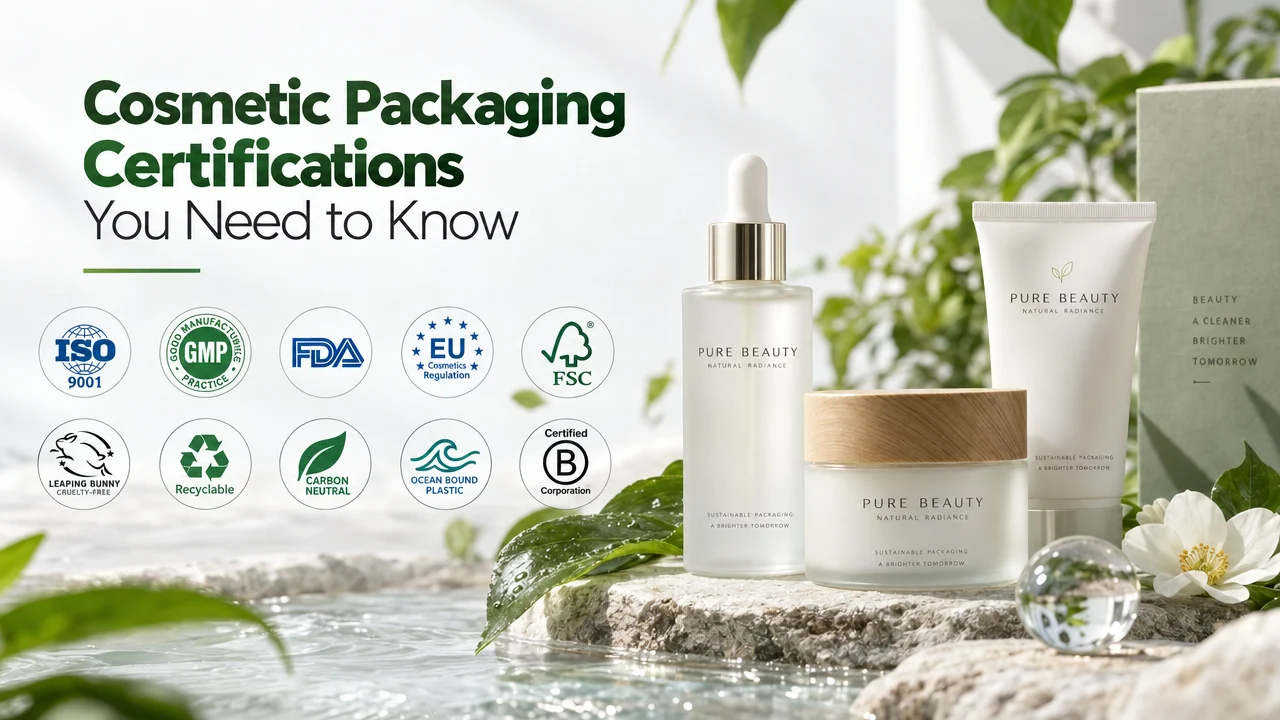
Choosing cosmetic packaging is not only about appearance, price, and functionality. Brands may also encounter certifications, standards, test reports, recycled-content claims, and sustainability credentials when evaluating packaging suppliers. The challenge is knowing which ones are actually relevant to your project—and which ones are simply being used as marketing language.
There is no single universal “cosmetic packaging certification” required for every bottle, jar, or tube. The certifications and documents you may need depend on the packaging material, target market, product, sustainability claims, and customer requirements. Common credentials can include ISO management-system certifications, FSC certification for paper-based materials, recycled-content certifications such as GRS or APR PCR, and packaging-specific test or compliance documentation.
The key is to understand what each certification actually proves before using it in procurement or marketing.
What Certifications Are Relevant to Cosmetic Packaging?
The first thing I recommend is separating certifications, standards, test reports, and regulatory requirements.
They are not the same thing.
For example:
- ISO 9001 → management-system certification
- FSC → certification related to responsible forest-based materials
- GRS → certification covering recycled materials and chain-of-custody requirements
- APR PCR Certification → verification related to post-consumer recycled plastic content
- ISO 22715 → guidance/standard related to cosmetic packaging and labeling
- Test report → evidence that a specific sample passed a specific test
- Regulatory compliance → meeting applicable legal requirements in a target market
This distinction is important.
A supplier saying:
“Our packaging is ISO certified.”
does not tell you enough.
You should ask:
Which ISO standard, what is certified, and does it apply to this packaging product?
Is There a Universal Cosmetic Packaging Certification?
No.
There is no single certification that automatically makes every cosmetic bottle compliant worldwide.
Requirements depend on:
- Country
- Product
- Packaging material
- Formula
- Claims
- Packaging structure
- Customer specifications
For example, a brand purchasing a standard PET serum bottle may have different documentation needs from a brand developing a PCR airless bottle with environmental claims.
Similarly, a carton made from paper may involve FSC certification, while a plastic bottle may require documentation concerning recycled content.
This is why I recommend creating a project-specific certification checklist rather than asking for every certificate available.
What Is ISO 22715 for Cosmetic Packaging?
ISO 22715, Cosmetics — Packaging and labelling, is an international standard associated with cosmetic packaging and labeling.
It provides guidance concerning packaging and labeling practices for cosmetic products.
However, it is important not to confuse ISO 22715 with a universal “cosmetic packaging safety certification.”
It does not mean that every cosmetic bottle carrying an “ISO 22715 certificate” has automatically passed every possible mechanical, chemical, or regulatory test.
For technical testing, brands may need additional methods depending on the package.
This is an important distinction when evaluating supplier documentation.
What Is ISO 9001 and Why Does It Matter for Packaging Suppliers?
ISO 9001 is a quality management system standard.
It is not a certification specifically for cosmetic bottles.
Instead, it evaluates whether an organization has a structured quality management system.
For a cosmetic packaging manufacturer, this can be relevant to processes such as:
- Quality planning
- Production control
- Document management
- Corrective actions
- Supplier management
- Continuous improvement
For a buyer, ISO 9001 certification can be one useful indicator that a supplier has formalized quality processes.
But it should not replace product-specific inspection.
A factory can have an ISO 9001-certified management system while an individual packaging product still requires testing and quality inspection.
What Is ISO 14001 for Cosmetic Packaging?
ISO 14001 is an environmental management system standard.
It focuses on how an organization manages its environmental responsibilities.
For packaging suppliers, it may relate to areas such as:
- Resource management
- Waste
- Environmental processes
- Energy use
- Environmental objectives
ISO 14001 is therefore different from a certificate proving that a specific cosmetic bottle is recyclable.
It tells you about the organization’s environmental management system rather than automatically proving the environmental performance of an individual package.
This distinction is important when evaluating sustainability claims.
What Is FSC Certification for Cosmetic Packaging?
FSC certification is particularly relevant to paper and paperboard packaging.
For cosmetic brands, it can be relevant to:
- Folding cartons
- Paper boxes
- Paper labels
- Other forest-based packaging materials
FSC certification is designed to provide assurance concerning responsibly sourced forest-based materials and chain of custody.
If your cosmetic packaging includes a paper carton and your brand wants to make a responsible-sourcing claim, FSC-certified material may be relevant.
However, FSC applies to forest-based materials.
It does not certify a plastic cosmetic bottle.
What Is PCR Certification?
PCR means Post-Consumer Recycled.
PCR plastic is material recovered from products that consumers have already used and discarded, then processed for use in new products.
For example:
Used Plastic → Collection → Sorting → Recycling → PCR Material → New Cosmetic Packaging
Brands increasingly use PCR plastic for sustainability goals.
However, simply saying:
“This bottle contains PCR.”
does not necessarily tell the buyer how much recycled content it contains or how that content was verified.
This is where recycled-content certification and chain-of-custody documentation can become useful.
What Does APR PCR Certification Mean?
The Association of Plastic Recyclers (APR) provides a PCR Certification program involving third-party assessment and verification of post-consumer recycled content and its traceability.
APR describes its PCR Certification as a full-chain-of-custody, third-party assessment and verification process for post-consumer recycled content.
This can be particularly relevant to brands that want stronger evidence for recycled-content claims.
However, the buyer should still confirm:
- Recycled content percentage
- Material type
- Certification scope
- Certified company
- Validity
- Whether the certification covers the material used in your actual product
What Is GRS Certification?
GRS, or Global Recycled Standard, is a voluntary standard associated with recycled materials and chain-of-custody requirements.
It can be relevant when brands want to verify recycled content and responsible processing practices.
GRS can cover requirements beyond simply proving that recycled material exists, including social, environmental, and chemical-related criteria within its scope.
For packaging buyers, it can be useful when developing sustainability-focused packaging.
However, the exact certificate scope matters.
A supplier may have GRS certification for a particular facility, material, or product scope.
That does not automatically mean every product manufactured by the company is GRS-certified.
What Is Recycled Paper Certification?
For paper-based cosmetic packaging, brands may encounter certifications related to responsible forestry and recycled content.
Examples include:
- FSC
- PEFC
- Recycled-content verification schemes
The appropriate certification depends on what the brand wants to substantiate.
For example:
“Made with responsibly sourced paper”
is different from:
“Made with 100% recycled paper.”
The supporting evidence may therefore be different.
Brands should ensure that the certification matches the exact environmental claim being made.
What Is the Difference Between PCR and PIR?
This is a common source of confusion.
PCR
Post-Consumer Recycled
Material comes from products that have been used by consumers and then recovered for recycling.
PIR
Post-Industrial Recycled
Material comes from manufacturing or industrial processes before it becomes consumer waste.
For example, production scrap from a factory may be classified as post-industrial material.
The two materials are not equivalent.
If your marketing message specifically focuses on post-consumer recycled plastic, you should not replace PCR with PIR without clearly communicating the difference.
Does PCR Plastic Need Certification?
Not necessarily in every situation.
A product can contain PCR material without a certification being legally required for every application.
However, certification or third-party verification can provide stronger evidence when a brand makes recycled-content claims.
A buyer should ask for documentation showing:
- PCR percentage
- Material source
- Chain of custody
- Certification body
- Certificate number
- Validity period
- Certified scope
This is particularly important when recycled content is part of the product’s marketing strategy.
What Are the Requirements for Packaging in the EU?
The European Union has increasingly strict requirements concerning packaging waste, recyclability, recycled content, and environmental performance.
The Packaging and Packaging Waste Regulation (PPWR) is an important development for companies placing packaging on the EU market.
However, EU packaging requirements are different from cosmetic-product regulations.
This means brands should consider both:
Cosmetic Product Regulation
and
Packaging and Packaging Waste Requirements
when preparing products for Europe.
The exact obligations depend on the packaging and market situation.
For current information, brands should consult the official EU legislation and relevant national requirements.
European Commission – Packaging and Packaging Waste
Are Cosmetic Packaging Certifications Required by the FDA?
This is another area where buyers often misunderstand certification.
The FDA does not provide a universal “FDA certification” for ordinary cosmetic packaging that makes a package automatically approved for cosmetic use.
US cosmetic compliance involves the finished cosmetic product, labeling, safety, and applicable federal requirements.
For packaging materials, the appropriate documentation depends on the material, intended use, and product.
Therefore, be cautious if a supplier simply tells you:
“This cosmetic bottle is FDA certified.”
Ask for clarification.
You should find out:
- What exactly is certified?
- Which material?
- Which test?
- Which regulation?
- Is there a test report?
- Does it apply to the final product?
Does EU Cosmetic Compliance Require a Packaging Certificate?
Not necessarily.
The EU cosmetics framework does not mean that every cosmetic bottle needs one universal “EU cosmetic packaging certificate.”
Instead, the finished cosmetic product must meet applicable requirements under the EU Cosmetics Regulation, including safety and labeling obligations.
Packaging plays an important role in product safety and compliance.
For example, the package needs to be appropriate for its intended use and should not create unacceptable problems with the formula.
Brands should therefore focus on evidence of suitability and compliance, rather than simply collecting certificates.
What Certifications Should a Cosmetic Packaging Manufacturer Have?
There is no universal list that every packaging manufacturer must possess.
However, depending on the project, useful credentials may include:
Quality Management
- ISO 9001
Environmental Management
- ISO 14001
Sustainable Materials
- FSC
- PEFC
- GRS
- Applicable recycled-content certification
Recyclability
- Relevant recyclability assessment or certification
Product-Specific Evidence
- Material specifications
- Test reports
- Compatibility data
- Quality inspection records
The important point is relevance.
A supplier with 20 certificates is not necessarily better than one with five relevant and verifiable certifications.
What Documents Should You Request From a Cosmetic Packaging Supplier?
When evaluating a supplier, I recommend requesting documentation according to your actual project.
For Plastic Packaging
Ask about:
- Material specification
- Resin information
- PCR percentage if applicable
- Recycled-content evidence
- Quality inspection records
- Relevant test reports
For Paper Packaging
Consider:
- FSC or PEFC documentation where relevant
- Paper specifications
- Recycled-content information
For Custom Packaging
Request:
- Mold specifications
- Approved samples
- Dimensional records
- Decoration specifications
- Quality standards
For Sustainable Packaging
Ask:
“What evidence supports this sustainability claim?”
This is much more useful than simply asking:
“Is this eco-friendly?”
How Do You Verify a Cosmetic Packaging Certificate?
Never rely solely on a certificate image sent by email.
Check:
- Certificate holder
- Company name
- Certification body
- Certificate number
- Issue date
- Expiration date
- Scope
- Certified facility
- Product/material covered
The scope is particularly important.
For example, a supplier may show a certificate for one factory or one material while quoting another product from another facility.
Always confirm that the certificate actually applies to your project.
Are Certifications More Important Than Packaging Testing?
No.
They serve different purposes.
A certification may demonstrate that:
- A management system meets a standard
- A recycled material supply chain has been verified
- A forest-based material meets a sourcing standard
A product test may demonstrate that:
- A bottle does not leak
- A pump works correctly
- A package survives a drop
- A decoration remains attached
You may need both.
For example:
GRS Certification + Formula Compatibility Testing + Leakage Testing + Production QC
can provide much more useful evidence than any single certificate.
[Internal Link: Cosmetic Packaging Testing Standards]
Can a Certificate Guarantee Cosmetic Packaging Quality?
No certificate can replace product-specific quality control.
Quality depends on:
- Material
- Manufacturing process
- Mold condition
- Production parameters
- Decoration
- Assembly
- Storage
- Transportation
A supplier may hold a valid management-system certification while individual production batches still require inspection.
That is why I recommend using a combination of:
Supplier Qualification + Certification Verification + Sample Approval + Product Testing + Production QC
What Certifications Matter Most for Sustainable Cosmetic Packaging?
For sustainability-focused projects, the most relevant credentials depend on the material.
Plastic
Potentially relevant:
- GRS
- APR PCR Certification
- Other recycled-content verification
- Recyclability assessments
Paper
Potentially relevant:
- FSC
- PEFC
- Recycled-content certification
Manufacturing Facility
Potentially relevant:
- ISO 14001
- Other environmental management credentials
The key is matching the certification to the claim.
For example:
“Our factory has ISO 14001 certification”
does not prove:
“This bottle contains 50% PCR.”
And:
“This carton is FSC certified”
does not prove:
“The entire cosmetic package is recyclable.”
Specific claims require specific evidence.
How Can Brands Avoid Certification Mistakes?
Here are several mistakes I see buyers make.
Mistake 1: Asking for “FDA Certification”
Ask what specific FDA requirement or documentation is relevant instead.
Mistake 2: Treating ISO 22715 as a Universal Packaging Certificate
ISO 22715 is related to cosmetic packaging and labeling. It is not a universal certification covering every packaging performance requirement.
Mistake 3: Assuming PCR Means Certified PCR
PCR describes the material source.
Certification provides additional verification where applicable.
Mistake 4: Assuming One Certificate Covers Every Product
Always check the certificate scope.
Mistake 5: Using Certification Logos Without Permission
Certification marks are generally subject to rules governing their use.
Brands should follow the relevant certification organization’s requirements before placing logos on packaging or marketing materials.
What Should You Ask a Cosmetic Packaging Manufacturer?
Before choosing a supplier, I recommend asking:
What certifications does your factory currently hold?
Then ask:
Which certifications apply specifically to the packaging I am purchasing?
For sustainable packaging, ask:
Can you verify the recycled content and provide chain-of-custody documentation?
For quality:
What product-specific testing do you perform?
For custom packaging:
Can you provide material specifications and quality-control documentation?
For international markets:
What experience do you have exporting packaging to the USA, Europe, and Australia?
These questions provide much more useful information than simply asking:
“Are you certified?”
How Can Comaypack Support Certified and Sustainable Packaging Projects?
At Comaypack, our focus is helping beauty brands turn packaging requirements into practical manufacturing solutions.
Our capabilities include:
- OEM/ODM packaging development
- Custom mold development
- Plastic cosmetic bottles
- Lotion bottles
- Serum bottles
- Airless bottles
- Cream jars
- Surface treatment
- Spray coating
- Electroplating
- Silk printing
- Hot stamping
- Assembly
- Quality control
- International export
For brands developing more sustainable packaging, we can also discuss material options such as PCR plastic, depending on the packaging structure and project requirements.
For certification-dependent projects, the important step is to define the required certification before production.
We can then evaluate the packaging and manufacturing requirements around that specification.
Our export experience includes customers in the USA, Europe, and Australia, giving us experience supporting brands with different packaging expectations and documentation needs.
Cosmetic Packaging Certifications FAQs
What certifications are needed for cosmetic packaging?
There is no single certification required for every cosmetic package. Depending on the project, brands may need or benefit from certifications such as ISO 9001, FSC, GRS, recycled-content verification, or relevant test documentation. Requirements depend on the market, material, product, and claims.
What is PCR certification?
PCR certification or verification provides evidence concerning post-consumer recycled content and, depending on the program, its traceability through the supply chain. APR PCR Certification is one example of a third-party verification program.
What does APR PCR certification mean?
APR PCR Certification is a third-party assessment and verification program focused on post-consumer recycled content and chain of custody. Brands should confirm the certificate’s scope and whether it covers the material used in their packaging.
What is GRS certification?
The Global Recycled Standard (GRS) is a voluntary standard covering recycled materials and chain-of-custody requirements, along with additional social, environmental, and chemical criteria within its scope.
Is FSC certification relevant to cosmetic packaging?
Yes, when cosmetic packaging contains paper or other relevant forest-based materials. FSC certification can help support responsible-sourcing claims for qualifying materials. It does not certify plastic cosmetic bottles.
Is ISO 22715 a cosmetic packaging certification?
ISO 22715 is an international standard concerning cosmetics packaging and labeling. It should not be treated as a universal certificate proving that a cosmetic package has passed every safety, compatibility, mechanical, or regulatory test.
Does FDA certify cosmetic packaging?
There is no universal FDA “cosmetic packaging certification” that automatically approves ordinary cosmetic packaging. The relevant US requirements depend on the material, product, intended use, and applicable federal regulations.
Does cosmetic packaging need certification to be sold in Europe?
Not every cosmetic package needs a single certification. Products placed on the EU market must comply with applicable cosmetic and packaging requirements. Specific documentation and certifications may be relevant depending on materials, sustainability claims, and other project requirements.
Is a test report the same as a certification?
No. A test report records the results of a particular test under specified conditions. A certification generally involves a defined certification scheme and scope. Neither should automatically be treated as universal regulatory approval.
Conclusion
Cosmetic packaging certifications are useful tools for verifying quality systems, material sourcing, recycled content, sustainability claims, and other specific requirements—but there is no single certificate that proves a cosmetic package is compliant everywhere. Brands should match each certification or document to the actual packaging material, product, target market, and claim.
When evaluating suppliers, I recommend looking beyond a list of logos.
Instead, ask:
What is certified?
Who certified it?
What is the scope?
Is it still valid?
Does it apply to my packaging?
What additional testing or documentation is required?
This approach makes supplier qualification much more reliable.
For a cosmetic packaging project, the ideal process is:
Define Requirements → Select Material → Verify Certifications → Develop Packaging → Test → Approve Sample → Mass Production
At Comaypack, we support beauty brands with OEM/ODM cosmetic packaging development, mold development, plastic bottle manufacturing, surface treatment, assembly, quality control, and international export.
If you are looking for packaging for a skincare or beauty product and need specific material, recycled-content, quality, or documentation requirements, we can help you evaluate the appropriate packaging solution.