
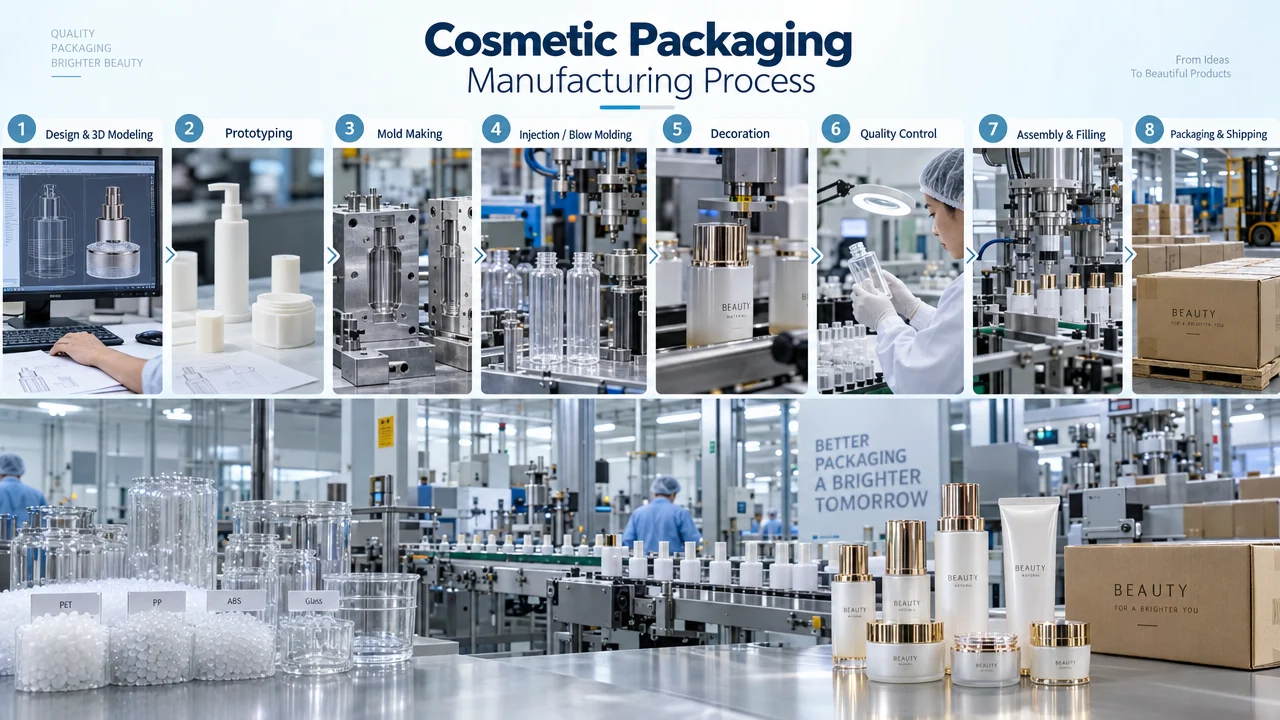
A cosmetic package may look simple when it reaches the customer, but manufacturing it involves multiple stages. From material selection and mold development to injection molding, surface treatment, assembly, and quality control, each step can affect the final product. Understanding the process helps beauty brands choose suppliers and avoid costly production problems.
The cosmetic packaging manufacturing process typically includes product design, material selection, mold development, prototyping, molding, surface treatment, printing, assembly, quality inspection, and final packaging. The exact process depends on the packaging type and material. For plastic cosmetic bottles, common manufacturing methods include injection molding and extrusion blow molding, followed by decoration, component assembly, testing, and mass production.
A clear manufacturing process helps brands turn a packaging concept into a consistent, production-ready product.
What Is the Cosmetic Packaging Manufacturing Process?
Cosmetic packaging manufacturing is the process of turning a packaging concept or design into a finished container that can be filled, decorated, assembled, and delivered to the customer.
For a custom plastic cosmetic bottle, the process may look like this:
Design → Material Selection → Mold Development → Prototype → Testing → Molding → Decoration → Assembly → Quality Control → Packaging → Delivery
Each stage has a different purpose.
A mistake made early in the process can create problems later.
For example, an unsuitable bottle structure may require a mold change. Poor material selection may create formula compatibility problems. Incorrect decoration specifications can cause inconsistent colors during mass production.
This is why I recommend treating packaging manufacturing as a complete development process rather than simply placing an order for bottles.
What Are the Main Stages of Cosmetic Packaging Manufacturing?
Although different packaging products require different production methods, most custom cosmetic packaging projects involve several core stages.
1. Packaging Design
The process begins with a concept.
The brand may provide:
- A 3D design
- A drawing
- A reference bottle
- A physical sample
- A rough packaging concept
At this stage, the manufacturer evaluates whether the proposed design can be produced.
Important considerations include:
- Bottle dimensions
- Capacity
- Shape
- Wall thickness
- Neck size
- Closure
- Pump or dispenser
- Material
- Decoration
- Production quantity
A visually attractive design still needs to be technically feasible.
2. Material Selection
The next step is selecting an appropriate material.
For plastic cosmetic packaging, common materials include:
- PET
- PP
- PE
- PCR plastic
The choice depends on the packaging structure and product requirements.
For example, different components of a package may use different materials.
A bottle, pump, cap, and inner component do not necessarily need to use the same plastic.
Material selection can affect:
- Appearance
- Strength
- Chemical resistance
- Weight
- Cost
- Transparency
- Surface finish
- Recyclability
Formula compatibility should also be considered.
[Internal Link: Sustainable Cosmetic Packaging Materials]
How Are Cosmetic Packaging Molds Developed?
For custom packaging, mold development is one of the most important manufacturing stages.
A mold determines the physical structure of the package.
For example, a custom bottle mold can determine:
- Bottle shape
- Dimensions
- Surface details
- Neck structure
- Wall structure
- Production consistency
The basic process may include:
3D Design → Mold Design → Mold Manufacturing → Mold Trial → Sample → Modification → Final Approval
Why Is Mold Development Important?
A poorly designed mold can create problems such as:
- Uneven walls
- Dimensional inconsistencies
- Poor appearance
- Difficult demolding
- Production inefficiency
A well-developed mold, on the other hand, provides a stable foundation for mass production.
This is especially important when a brand plans to order large quantities.
How Are Plastic Cosmetic Bottles Manufactured?
Different plastic bottles can require different molding processes.
Two common methods are injection molding and blow molding.
Injection Molding
Injection molding is widely used for plastic packaging components such as:
- Caps
- Closures
- Pumps components
- Jars
- Certain bottle structures
Plastic material is heated and injected into a mold cavity.
Once the material cools and solidifies, the component is removed from the mold.
The process can produce highly consistent components when the mold and production parameters are properly controlled.
Blow Molding
Blow molding is commonly used to manufacture hollow plastic containers.
It can be used for certain:
- Cosmetic bottles
- Lotion bottles
- Personal care containers
A heated plastic preform or tube-like material is placed into a mold and expanded against the mold walls using air pressure.
The resulting container takes the shape of the mold.
The appropriate molding process depends on the packaging structure, material, dimensions, and production requirements.
How Are Cosmetic Cream Jars Manufactured?
Cream jars may use a different manufacturing process from bottles.
Depending on the design and material, a jar may involve:
Material Preparation → Injection Molding → Trimming/Finishing → Decoration → Assembly → Inspection
A cream jar may also contain several components, such as:
- Outer jar
- Inner jar
- Lid
- Liner
- Decorative components
Each component needs to fit correctly.
A small dimensional issue can affect:
- Closure
- Sealing
- Appearance
- User experience
For premium cream jars, surface treatment and decoration can also become an important part of the manufacturing process.
How Are Airless Cosmetic Bottles Manufactured?
Airless packaging has additional functional requirements compared with a simple bottle.
An airless package can contain several components, including:
- Outer bottle
- Inner container or piston system
- Pump
- Actuator
- Closure
The components need to work together correctly.
The manufacturing process therefore involves more than producing the outer bottle.
The complete dispensing system needs to be assembled and tested.
Important checks may include:
- Pump performance
- Product dispensing
- Component fit
- Leakage
- Priming
- Formula compatibility
This is why brands should test the complete airless packaging system with the actual formula before mass production.
How Are Cosmetic Packaging Pumps and Closures Manufactured?
Pumps and closures are precision components.
A pump may contain several small parts, including:
- Actuator
- Spring
- Housing
- Piston
- Gasket
- Dip tube
The exact structure varies by pump type.
During production, components may be molded separately and then assembled.
Quality control needs to consider:
- Pump dosage
- Smooth operation
- Leakage
- Closure fit
- Component consistency
For a cosmetic brand, a beautiful bottle cannot compensate for a pump that does not work properly.
The bottle and dispensing system should therefore be developed as one packaging solution.
How Does Cosmetic Packaging Decoration Work?
Once the basic packaging components have been manufactured, the package can be decorated.
This is where a standard bottle can become a finished branded product.
Common cosmetic packaging decoration methods include:
Spray Coating
Spray coating can change the package’s color, opacity, and surface appearance.
It can create:
- Matte finishes
- Glossy finishes
- Custom colors
- Soft-touch effects
Electroplating
Electroplating can create metallic visual effects on suitable components.
It is often used when brands want a more premium appearance.
Silk Printing
Silk printing can apply:
- Logos
- Product names
- Text
- Decorative graphics
directly to the packaging surface.
Hot Stamping
Hot stamping can create metallic or specialty lettering and graphics.
It is commonly used for:
- Logos
- Brand names
- Decorative details
The appropriate decoration process depends on the packaging material, surface, design, quantity, and desired finish.
How Important Is Color Matching in Cosmetic Packaging Manufacturing?
Color consistency is particularly important for branded cosmetic packaging.
A brand may have a specific color that needs to remain consistent across:
- Bottles
- Jars
- Caps
- Cartons
- Other packaging materials
However, the same color can appear differently depending on the material and surface.
A glossy surface can reflect light differently from a matte surface.
A transparent material can also produce a different visual result from an opaque material.
For this reason, brands should approve physical color samples rather than relying only on digital artwork.
A good production process should establish clear color references before mass production.
How Is Cosmetic Packaging Assembled?
Some cosmetic packages are made from multiple components.
For example:
Bottle + Pump + Cap + Dip Tube
or:
Cream Jar + Inner Lid + Outer Lid
These components need to be assembled correctly.
Assembly may involve:
- Component insertion
- Pump installation
- Closure fitting
- Inner component installation
- Decoration inspection
Depending on the product, assembly may be performed manually, automatically, or through a combination of processes.
The goal is consistent fit and reliable performance.
What Quality Tests Are Used for Cosmetic Packaging?
Quality control should take place throughout the manufacturing process, not only at the end.
Common checks can include:
Appearance Inspection
Checking for:
- Scratches
- Black spots
- Color differences
- Deformation
- Surface defects
Dimensional Inspection
Checking whether the package meets approved specifications.
Leakage Testing
Important for bottles, pumps, and closures.
Drop Testing
Can help evaluate packaging durability during handling.
Dispensing Testing
Used for pumps, droppers, and other dispensing systems.
Assembly Testing
Confirms that components fit together properly.
Decoration Testing
Evaluates printing, coating, hot stamping, and other surface treatments.
The exact testing requirements depend on the product and packaging structure.
Why Is Packaging Compatibility Testing Important?
A cosmetic package can pass visual and mechanical tests but still be unsuitable for the formula.
This is because the formula and packaging may interact over time.
Potential issues can include:
- Discoloration
- Swelling
- Cracking
- Leakage
- Changes in dispensing performance
For example, a formula containing certain oils or active ingredients may require careful packaging selection.
This is why I recommend testing the actual formula in the actual packaging rather than relying only on a generic packaging sample.
[Internal Link: Cosmetic Packaging Compatibility Testing]
What Happens Before Cosmetic Packaging Goes Into Mass Production?
Before mass production begins, the brand and manufacturer should confirm the final specifications.
These may include:
- Packaging dimensions
- Material
- Capacity
- Color
- Decoration
- Pump or closure
- Artwork
- Mold
- Assembly
- Packaging method
A final approved sample can serve as an important reference.
Once the specifications are confirmed, production can move forward.
This stage is especially important for custom packaging because changes after mass production begins can be expensive and time-consuming.
How Long Does Cosmetic Packaging Manufacturing Take?
There is no single lead time for cosmetic packaging manufacturing.
The timeline depends on:
- Existing or custom mold
- Product complexity
- Material
- Decoration
- Order quantity
- Testing requirements
- Assembly
- Production capacity
A standard packaging item may have a relatively straightforward production process.
A completely custom bottle requires more stages.
For a custom project, the overall timeline may include:
Design → Mold → Sampling → Testing → Production → Decoration → Assembly → QC → Delivery
Brands should therefore discuss the complete timeline with the manufacturer before setting a product launch date.
What Is the Difference Between Standard and Custom Cosmetic Packaging?
Standard Packaging
Standard packaging already exists and generally uses an established mold.
Advantages may include:
- Faster development
- Lower tooling requirements
- Easier sampling
- More predictable production
It can be a good option for brands working with limited development time.
Custom Packaging
Custom packaging is developed specifically for the brand.
It can provide:
- Unique shapes
- Custom dimensions
- Stronger differentiation
- Brand-specific structures
However, it can also involve:
- Mold costs
- Longer development
- Higher MOQs
- More testing
The right choice depends on the brand’s budget, positioning, timeline, and expected production volume.
How Can Brands Reduce Cosmetic Packaging Manufacturing Costs?
Cost optimization should begin during the design stage.
Some possible approaches include:
Simplify the Mold
An overly complicated mold can increase tooling and production costs.
Optimize Material Use
Reducing unnecessary material can potentially lower both material and transportation costs.
Choose Appropriate Decoration
Not every package needs multiple decoration processes.
Sometimes one carefully selected finish can create the desired effect.
Optimize Components
Reducing unnecessary components may simplify assembly.
Plan Production Volume
Higher production volumes may change the unit economics of packaging.
However, brands should not choose the cheapest packaging simply because the unit price is lower.
A better approach is to evaluate:
Packaging Cost + Tooling + Decoration + Quality + Logistics + Lead Time
This gives a more realistic view of total cost.
How Can an Experienced Cosmetic Packaging Manufacturer Help?
An experienced manufacturer can contribute throughout the entire development process.
Instead of simply manufacturing a finished design, the supplier can help with:
- Design feasibility
- Material selection
- Mold development
- Prototype development
- Packaging testing
- Decoration
- Assembly
- Quality control
- Production planning
- Delivery
This is particularly useful when a brand has a concept but does not have an internal packaging engineering team.
The manufacturer’s role can be summarized as:
Concept → Engineering → Manufacturing → Quality → Delivery
Cosmetic Packaging Manufacturing Process at Comaypack
At Comaypack, we support beauty brands through the major stages of cosmetic packaging development and manufacturing.
Our core focus is plastic cosmetic packaging, including:
- Lotion bottles
- Serum bottles
- Airless bottles
- Cream jars
- Custom plastic cosmetic packaging
OEM and ODM Development
Brands can work with us from an existing packaging concept or develop a more customized solution.
Our OEM/ODM capabilities can support:
- Product development
- Structural customization
- Sample development
- Custom packaging
Mold Development
For custom packaging, we support the transition from design concept to production mold.
The process can include:
3D Design → Mold Development → Prototype → Testing → Production
Surface Treatment
We provide several decoration options:
- Spray coating
- Electroplating
- Silk printing
- Hot stamping
These processes can help create the desired brand appearance and premium finish.
Production and Quality Control
We support:
- Sampling
- Mass production
- Quality inspection
- Assembly
- Production coordination
Global Export
Our international export experience includes customers in:
- USA
- Europe
- Australia
This allows us to support brands that need both manufacturing and international delivery.
What Should You Ask a Cosmetic Packaging Manufacturer?
Before placing a large order, I recommend asking the supplier several practical questions.
About Manufacturing
What production method is suitable for this packaging?
About Materials
Which material do you recommend for my formula and design?
About Mold Development
Do you provide custom mold development?
About Testing
What quality and performance tests do you perform?
About Decoration
Can you provide spray coating, electroplating, silk printing, or hot stamping?
About MOQ
What is the MOQ for this packaging?
About Lead Time
What is the sample and mass-production lead time?
About Quality
How do you maintain consistency between production batches?
About Export
Do you have experience exporting cosmetic packaging to my target market?
The answers to these questions can help you distinguish a packaging manufacturer from a simple trading supplier.
Cosmetic Packaging Manufacturing Process FAQs
What are the main steps in cosmetic packaging manufacturing?
The typical process includes design, material selection, mold development, prototyping, molding, decoration, assembly, quality control, final packaging, and delivery. The exact process depends on the packaging material and structure.
How are plastic cosmetic bottles manufactured?
Plastic cosmetic bottles can be produced using processes such as injection molding or blow molding, depending on the bottle design and material. After molding, bottles may undergo decoration, assembly, inspection, and testing.
How long does cosmetic packaging manufacturing take?
The lead time depends on whether the packaging uses an existing or custom mold, the packaging structure, material, decoration, order quantity, testing requirements, and production schedule. Custom packaging generally requires more development time than standard packaging.
What is the difference between injection molding and blow molding?
Injection molding forms plastic by injecting molten material into a mold. It is widely used for components such as caps, closures, and certain containers. Blow molding uses air pressure to expand heated plastic into a mold and is commonly used for hollow containers.
Can cosmetic packaging be customized?
Yes. Cosmetic packaging can be customized in areas such as shape, dimensions, material, color, surface finish, printing, hot stamping, and other decorative elements. Custom molds may be required for completely new packaging structures.
What testing should cosmetic packaging undergo?
Depending on the product, testing may include appearance inspection, dimensional checks, leakage testing, drop testing, dispensing tests, assembly checks, decoration testing, and formula compatibility testing.
How can I choose a cosmetic packaging manufacturer?
Evaluate the supplier’s manufacturing capabilities, mold development experience, material options, quality control, decoration capabilities, MOQ, lead time, communication, and international export experience. It is also useful to request samples before placing a mass-production order.
Conclusion
Cosmetic packaging manufacturing is a multi-stage process that turns a design concept into a reliable, production-ready package. From material selection and mold development to molding, decoration, assembly, testing, and quality control, every stage can affect the final product. Working with an experienced manufacturer early can help brands reduce production risks and create packaging that is both attractive and manufacturable.
A successful cosmetic packaging project does not end when the bottle looks good.
The package also needs to:
- Work with the formula
- Meet dimensional requirements
- Dispense correctly
- Survive transportation
- Maintain consistent appearance
- Be practical to manufacture
- Meet the brand’s cost and delivery requirements
For this reason, packaging manufacturing should be treated as part of the product development process.
At Comaypack, we help beauty brands move from packaging concepts to production through OEM/ODM development, mold development, plastic cosmetic packaging manufacturing, surface treatment, assembly, quality control, and global delivery.
If you are developing a new lotion bottle, serum bottle, airless bottle, cream jar, or custom cosmetic package, we can help you evaluate the manufacturing route and develop a practical solution.