
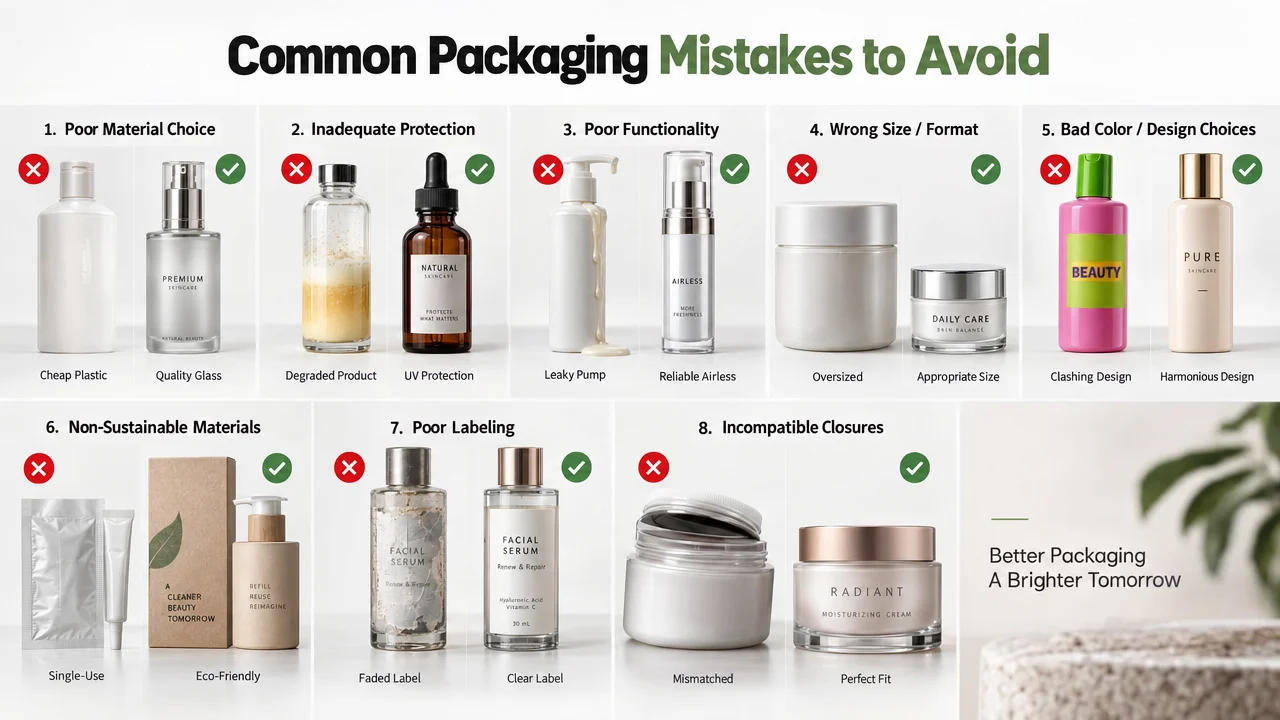
Cosmetic packaging can look perfect on screen but fail during testing, shipping, or mass production. Small mistakes can lead to leaks, compatibility problems, higher costs, and delayed launches. Knowing the most common packaging mistakes early can help beauty brands avoid expensive problems before production begins.
Common cosmetic packaging mistakes include prioritizing appearance over functionality, ignoring formula compatibility, skipping packaging tests, choosing unsuitable pumps or closures, overlooking specifications, failing to consider e-commerce shipping, misunderstanding sustainability claims, focusing only on unit price, and choosing a supplier without evaluating manufacturing capabilities. Avoiding these problems requires early testing, clear specifications, realistic cost planning, and close communication with an experienced cosmetic packaging manufacturer.
A beautiful package is only successful when it also protects the formula, works reliably, ships safely, and can be produced consistently.
What Are the Most Common Cosmetic Packaging Mistakes?
When developing a new skincare or beauty product, packaging may seem like one of the easier parts of the process.
Choose a bottle. Add a logo. Pick a color. Order samples.
In reality, cosmetic packaging involves many technical and commercial decisions.
The most common mistakes include:
- Choosing appearance over functionality
- Ignoring formula compatibility
- Skipping packaging testing
- Choosing the wrong pump, dropper, or closure
- Not defining packaging specifications
- Ignoring e-commerce and transportation
- Assuming every “eco-friendly” material is sustainable
- Looking only at unit price
- Choosing a supplier too late
- Failing to plan for mass production
Let’s look at how brands can avoid each one.
Mistake #1: Prioritizing Appearance Over Functionality
A beautiful bottle can make a strong first impression.
For a beauty brand, packaging needs to communicate the right image. Luxury brands may want elegant shapes and premium finishes, while minimalist skincare brands may prefer clean and simple designs.
But appearance should not be the only consideration.
A bottle also needs to:
- Protect the formula
- Dispense the product properly
- Prevent leakage
- Withstand normal handling
- Provide a good user experience
For example, a serum bottle may look attractive but become difficult to use if the dropper does not deliver the right amount of product.
Similarly, a lotion bottle with an attractive shape may not work well if the pump cannot handle the formula viscosity.
How to Avoid This Mistake
I recommend evaluating design and functionality together from the beginning.
Before approving a cosmetic bottle, ask:
Does this packaging look good, and does it work well with the product?
The answer to both questions needs to be yes.
Mistake #2: Ignoring Formula Compatibility
One of the most important cosmetic packaging considerations is compatibility between the formula and the packaging.
A package that works perfectly for one skincare formula may not perform the same way with another.
Brands should consider factors such as:
- pH
- Alcohol content
- Essential oils
- Active ingredients
- Oil-based formulas
- Water-based formulas
- Fragrances
The formula can interact with certain packaging materials or components over time.
Potential problems may include:
- Discoloration
- Swelling
- Cracking
- Leakage
- Changes in dispensing performance
- Product contamination
How to Avoid This Mistake
Don’t select packaging based only on a catalog photo or sample appearance.
Instead, test the actual formula with the actual packaging.
A compatibility evaluation can help identify potential problems before mass production.
Packaging Compatibility Testing Guide
Mistake #3: Skipping Cosmetic Packaging Testing
A sample can look perfect and still fail during real-world use.
This is why packaging testing should happen before mass production.
Depending on the product and packaging structure, testing may include:
Leakage Testing
Checks whether the bottle, pump, cap, or closure can maintain a reliable seal.
Drop Testing
Helps evaluate how the package responds to accidental drops and handling.
Dispensing Testing
Confirms whether the pump, dropper, or other dispenser delivers the product consistently.
Compatibility Testing
Evaluates how the packaging interacts with the formula.
Transportation Testing
Helps assess whether the package can withstand shipping and handling.
Decoration Testing
Checks whether printing, coating, hot stamping, or other finishes remain acceptable during handling.
The exact tests required depend on the packaging and product.
The important principle is simple:
A sample that looks good is not necessarily production-ready.
Testing early is generally much less expensive than discovering a packaging problem after thousands of units have been produced.
Mistake #4: Choosing the Wrong Pump, Dropper, or Closure
A cosmetic package is more than the bottle itself.
The complete system may include:
Bottle + Pump + Closure + Formula
If one component is unsuitable, the entire user experience can suffer.
Common problems include:
- Pump leakage
- Poor dispensing
- Loose caps
- Inconsistent dosage
- Difficult opening
- Poor sealing
This is particularly important for:
- Lotion bottles
- Serum bottles
- Airless bottles
- Dropper bottles
For example, a high-viscosity cream may require a different dispensing system from a lightweight serum.
How to Avoid This Mistake
Don’t choose the bottle first and treat the pump or closure as an afterthought.
The components should be evaluated as a complete packaging system.
Before mass production, test the complete assembly with the actual product formula.
Mistake #5: Not Defining Packaging Specifications
Another common problem happens during supplier communication.
A brand may tell a manufacturer:
“We need a 50ml luxury serum bottle.”
That information is not enough to define a production-ready package.
Important specifications may include:
- Capacity
- Fill volume
- Dimensions
- Neck size
- Material
- Bottle weight
- Pump dosage
- Closure type
- Color
- Decoration
- Tolerance
- Packaging method
These details affect both product performance and manufacturing.
How to Avoid This Mistake
Create a clear packaging specification sheet before requesting final quotations or approving production.
The more precise the specifications are, the easier it becomes for a manufacturer to provide an accurate solution.
It also reduces misunderstandings between the brand, designer, packaging supplier, and filling facility.
Mistake #6: Ignoring E-Commerce and Transportation
A cosmetic package may look perfect on a retail shelf but face very different conditions when shipped directly to consumers.
This is especially important for brands selling through:
- Shopify
- Amazon
- DTC websites
- Social commerce
During transportation, packages may experience:
- Drops
- Vibration
- Pressure
- Temperature changes
- Repeated handling
A fragile bottle or poorly sealed pump can become a serious problem once thousands of orders are shipped.
How to Avoid This Mistake
If your brand relies heavily on e-commerce, consider shipping conditions during the packaging development stage.
The package should be evaluated together with:
- Secondary packaging
- Protective inserts
- Cartons
- Shipping configuration
Cosmetic Packaging Shipping Test Guide
The goal is not simply to create packaging that looks good in photographs. It needs to arrive at the customer’s door in good condition.
Mistake #7: Assuming Every “Eco-Friendly” Material Is Sustainable
Sustainability is becoming increasingly important in cosmetics.
But one of the easiest mistakes is assuming that every material marketed as “green” is automatically the better choice.
For example:
Recyclable ≠ Recycled
PCR ≠ Recyclable
Bio-based ≠ Biodegradable
Refillable ≠ Automatically Sustainable
A sustainable packaging decision should consider the complete lifecycle:
Material → Manufacturing → Transportation → Use → End-of-life
For example, a heavier package may use a material that sounds more sustainable but require significantly more transportation weight.
Likewise, a recyclable package may have limited practical recycling options in a particular market.
How to Avoid This Mistake
Ask suppliers for specific information about:
- Material composition
- Recycled content
- Recyclability
- Manufacturing
- Disposal
- Target-market requirements
You can learn more about this topic in our Eco-Friendly Cosmetic Packaging Guide and Sustainable Cosmetic Packaging Materials Guide.
Mistake #8: Looking Only at the Unit Price
Price is obviously important when sourcing cosmetic packaging.
But comparing suppliers based only on the unit price can create problems later.
Imagine two quotations:
Supplier A: $0.50 per bottle
Supplier B: $0.65 per bottle
At first glance, Supplier A looks cheaper.
But the actual project cost may also include:
- Mold costs
- Sampling
- Decoration
- Assembly
- Shipping
- Quality issues
- Rework
- Inventory
- Minimum order quantities
A cheaper bottle can become more expensive if it causes production delays, inconsistent quality, or high rejection rates.
How to Avoid This Mistake
Instead of looking only at unit price, evaluate the total cost of ownership.
Consider:
Packaging + Tooling + Decoration + Logistics + Quality + Lead Time
This gives you a more realistic picture of the cost.
Mistake #9: Choosing a Supplier Too Late
Some brands complete the entire packaging design before speaking with a manufacturer.
That can create unnecessary problems.
A design may look excellent but be difficult or expensive to manufacture.
An experienced cosmetic packaging manufacturer can provide input on:
- Packaging structure
- Material selection
- Mold development
- Decoration
- Production feasibility
- Cost optimization
How to Avoid This Mistake
Bring your packaging supplier into the project early.
The ideal development process can look like:
Concept → Design → Material → Mold → Sample → Testing → Production → Delivery
Early supplier involvement can help identify manufacturing limitations before they become expensive changes.
Mistake #10: Failing to Plan for Mass Production
A package that works for 1,000 units may not automatically be the best solution for 100,000 units.
As your brand grows, production requirements become more demanding.
You need to consider:
- Material supply
- Production capacity
- Color consistency
- Decoration consistency
- Quality control
- Lead time
- Packaging assembly
This is especially important for growing skincare brands.
A supplier should be able to support your current needs while also having a realistic plan for future production volumes.
How to Avoid This Mistake
Before selecting a supplier, ask:
Can this manufacturer support us if our order volume increases significantly?
The answer can have a major impact on your long-term packaging strategy.
How Can You Avoid Cosmetic Packaging Problems Before Mass Production?
A simple pre-production checklist can help reduce many common mistakes.
Product
- Is the formula compatible with the packaging?
- Is the dispensing system suitable?
- Does the package protect the formula?
Packaging
- Is the material appropriate?
- Are dimensions confirmed?
- Is the closure secure?
- Is the package easy for consumers to use?
Testing
- Has leakage testing been completed?
- Has drop testing been considered?
- Has formula compatibility been evaluated?
- Has dispensing performance been tested?
- Has transportation been considered?
Production
- Is the mold finalized?
- Is the MOQ suitable?
- Can the supplier meet the required volume?
- Is the lead time realistic?
Decoration
- Is the color approved?
- Is printing consistent?
- Has the final decorated sample been approved?
- Can the supplier maintain the finish during mass production?
This checklist can help brands identify problems before they become expensive production issues.
What Should You Ask a Cosmetic Packaging Manufacturer?
Before choosing a supplier, I recommend asking specific questions instead of simply requesting a catalog and price list.
About Materials
What material options do you recommend for my formula?
About Compatibility
Can you support packaging compatibility testing?
About Customization
Can you develop a custom mold for our design?
About Testing
What tests do you perform before mass production?
About Quality
How do you control quality during production?
About Lead Time
What is the sample development and mass-production lead time?
About MOQ
What is the MOQ for this packaging?
About Decoration
What surface treatment options are available?
About Export
Do you have experience exporting cosmetic packaging to our target market?
The answers can tell you much more about a supplier than a low initial quotation.
How Can an Experienced Packaging Manufacturer Help?
A good packaging manufacturer should do more than manufacture a bottle after receiving a finished design.
The supplier can become part of the development process:
Design → Material → Mold → Sample → Testing → Production → Delivery
This can help brands identify potential problems earlier.
For example, a manufacturer may suggest a structural adjustment that:
- Improves strength
- Reduces material use
- Simplifies production
- Reduces tooling complexity
- Improves the final cost
This type of collaboration can be particularly valuable for brands developing custom cosmetic packaging for the first time.
Why Choose Comaypack for Cosmetic Packaging Development?
At Comaypack, we support beauty brands that need more than standard off-the-shelf packaging.
Our focus is on developing practical cosmetic packaging solutions that balance:
- Appearance
- Functionality
- Manufacturing feasibility
- Customization
- Cost
- Delivery requirements
OEM and ODM Development
We support:
- OEM cosmetic packaging
- ODM development
- Custom bottle development
- Custom packaging
- Mold development
- Sample development
If you have an initial concept rather than a finished package specification, our team can work with you through the development process.
Plastic Cosmetic Packaging Expertise
Our core product range includes:
- Lotion bottles
- Serum bottles
- Airless bottles
- Cream jars
- Custom plastic cosmetic bottles
Different products require different packaging solutions.
For example, an airless bottle may be appropriate for a particular skincare formula, while a traditional pump bottle or cream jar may be better for another product.
Our goal is to help brands select and develop packaging based on the actual product requirements.
Mold Development
Custom packaging often starts with the mold.
A well-designed mold can influence:
- Bottle shape
- Structural performance
- Production efficiency
- Visual consistency
- Manufacturing cost
Our mold development capability allows brands to move from an initial packaging concept toward a production-ready product.
Surface Treatment and Decoration
Packaging is also an important part of brand identity.
Our surface treatment capabilities include:
- Spray coating
- Electroplating
- Silk printing
- Hot stamping
The appropriate decoration method depends on the packaging material, design, durability requirements, and target market.
We recommend evaluating decoration as part of the complete packaging development process rather than as a final step added after everything else is decided.
Fast Delivery and Production Support
Once a package has been approved, reliable production and delivery become critical.
Comaypack supports customers with:
- Sample development
- Production coordination
- Quality control
- Manufacturing
- Delivery support
This helps brands manage the transition from packaging development to commercial production.
Global Export Experience
We work with customers in international markets, including:
- USA
- Europe
- Australia
For international beauty brands, successful packaging sourcing requires more than manufacturing capability.
Clear communication, consistent quality, production coordination, and reliable delivery are equally important.
Common Cosmetic Packaging Mistakes FAQs
What are the most common cosmetic packaging mistakes?
The most common mistakes include choosing appearance over functionality, ignoring formula compatibility, skipping testing, selecting unsuitable pumps or closures, overlooking specifications, failing to consider transportation, misunderstanding sustainability claims, focusing only on unit price, choosing a supplier too late, and failing to plan for mass production.
Why is cosmetic packaging compatibility important?
Packaging compatibility is important because cosmetic formulas can interact with packaging materials or components. Testing can help identify problems such as leakage, discoloration, cracking, swelling, or changes in dispensing performance before mass production.
How do you test cosmetic packaging?
Testing depends on the product and package but may include leakage, drop, compatibility, dispensing, transportation, and decoration testing. The exact testing program should be based on the formula, packaging structure, distribution method, and market requirements.
What should I consider when choosing cosmetic packaging?
Consider the formula, packaging material, functionality, design, dispensing system, durability, sustainability goals, cost, MOQ, lead time, transportation, and supplier manufacturing capabilities.
How can I avoid cosmetic packaging problems?
Start testing early, define packaging specifications clearly, evaluate the complete packaging system, and work with an experienced manufacturer. Early communication can help identify design and production problems before they become expensive.
How much does custom cosmetic packaging cost?
There is no single price for custom cosmetic packaging. Costs can depend on material, size, structure, mold requirements, MOQ, decoration, order quantity, and production specifications. Requesting a detailed quotation based on your actual project requirements provides a more accurate estimate.
Conclusion
Avoiding cosmetic packaging mistakes starts before production. Brands should evaluate formula compatibility, functionality, testing, specifications, shipping, sustainability, total cost, and supplier capabilities. Working with an experienced packaging manufacturer early can reduce development risks and help turn a packaging concept into a reliable, scalable product.
The best packaging is not necessarily the most expensive or visually impressive option.
It is the package that protects the formula, works for the consumer, survives transportation, fits the brand, and can be manufactured consistently at the required scale.
For brands developing a new skincare or beauty product, involving your packaging manufacturer early can make the entire process more efficient.
At Comaypack, we support cosmetic brands with OEM/ODM development, mold development, plastic cosmetic packaging, surface treatment, production, and international delivery.
If you already have a packaging concept, product formula, or reference bottle, our team can help you evaluate the next steps before mass production.
Talk to Our Cosmetic Packaging Team